

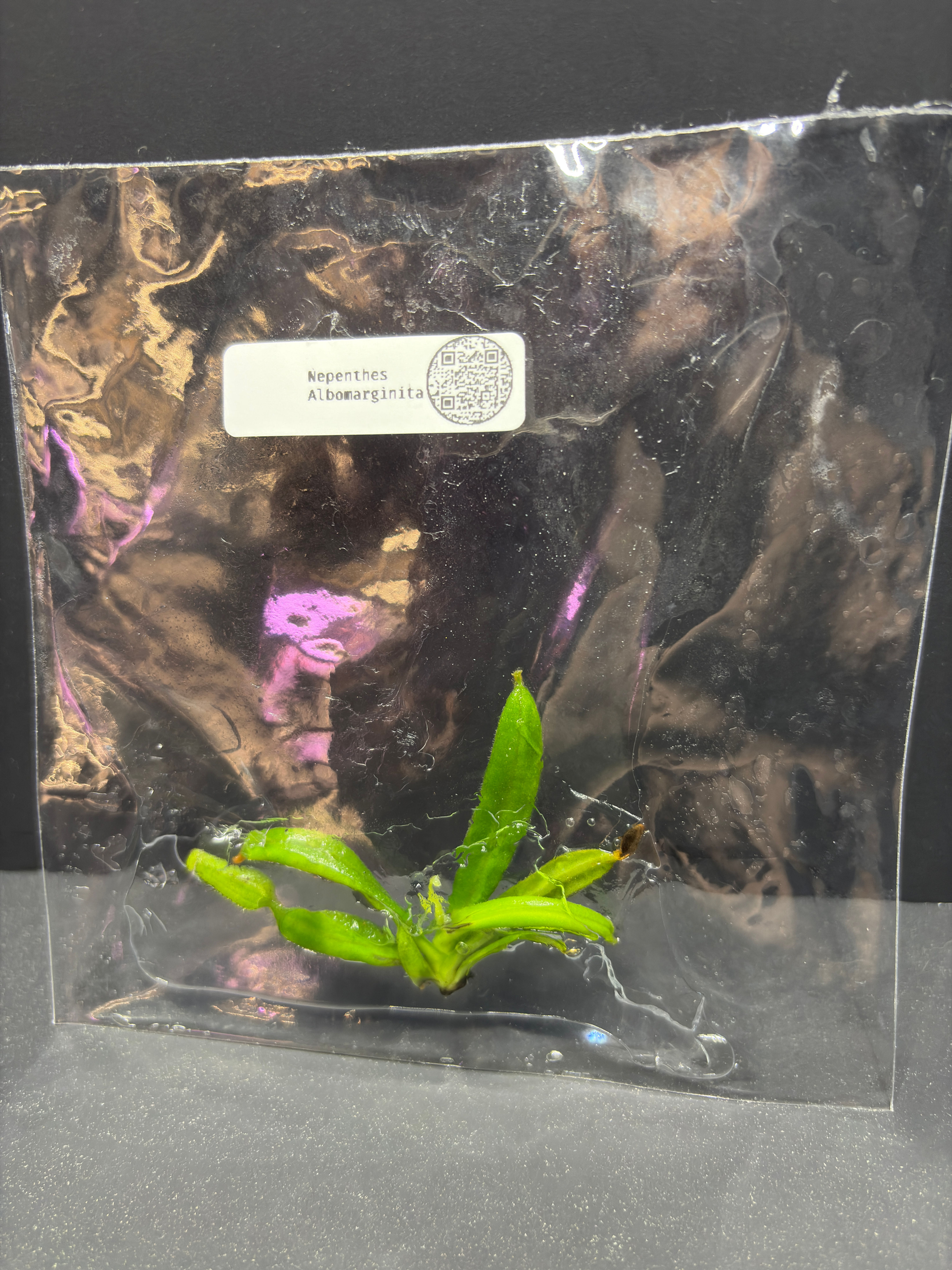

Nepenthes Albomarginata Tissue Culture
Introducing Nepenthes Albomarginata — one of the most unique and recognizable species in the Nepenthes genus! Famous for its striking snow-white peristome margin (the collar around the pitcher opening), this lowland pitcher plant produces elegant, cylindrical to slightly bulbous pitchers that contrast beautifully with the bright white band. Pitchers typically range from pale green to reddish-orange with speckling, creating a clean, high-contrast look that makes it a favorite among collectors.
Why collectors love it:
The unmistakable bright white peristome that stands out dramatically against the pitcher body — truly one-of-a-kind.
Graceful, elongated pitcher shape with a refined, tropical appearance.
Fascinating lowland species that shows excellent color and pitcher production under the right conditions.
Care Highlights:
Light: Bright, indirect light or dappled sunlight. Too much direct sun can stress the plant.
Water: Keep soil consistently moist but never soggy. Use only distilled, rain, or reverse osmosis water.
Humidity: High humidity preferred (70%+), though it can adapt better than many highland species.
Temperature: Lowland grower — enjoys warmer conditions: days 75–88°F (24–31°C), nights 65–75°F (18–24°C). Does not require cool nights.
Soil: Well-draining carnivorous mix (long-fiber sphagnum moss and perlite is ideal).
This fresh tissue culture plant is clean, pest-free, and ready to acclimate. A wonderful choice for growers looking for something truly distinctive in their carnivorous collection! 🪰🌿
Questions? Message me — happy to help with acclimation tips!
Thanks for supporting small plant growers! 🌱🪰
Check us out on social media - we're on Tiktok, Instagram, & Facebook @biteandbloombotanicals
Nepenthes Rebecca Soper
Nepenthes Albomarginata Tissue Culture Plant Seller's Choice
(General guidelines – NOT a one-size-fits-all! Every species (and even cultivar) can have slightly different needs. Always research your specific plant’s adult care requirements.)
• Do NOT skip acclimation – TC plants have lived in 100% humidity, sterile sugar-gel, and perfect lab conditions. Sudden change = shock or death. For carnivorous plants, make sure you are using an appropriate carnivorous substrate which is fertilizer free and appropriate water such as distilled, rain or reverse osmosis - NO tap. Please be aware that that variegation on tissue culture plants is never guaranteed to be stable as this is the nature of variegated plants, there is always a chance they can revert back to normal.
• Step 1 – Unboxing (Day 1)
• Open the package in low light / shade.
• Gently rinse off ALL agar/jelly under lukewarm water (use distilled or rainwater if your tap is hard/fluoridated).
• Remove any dead or black leaves with sterilized scissors.
• Step 2 – First 2–4 weeks (High-humidity phase)
• Pot in a very airy, sterile mix (e.g., pure sphagnum moss, 50/50 fluval stratum/perlite.
• Water with distilled, RO, or rainwater until established (tap water minerals can burn tiny roots).
• Place inside a clear plastic box, propagation dome, or large clear bag to keep humidity 85–100%.
• Bright indirect light only (50–150 µmol/m²/s or normal room light, no direct sun).
• Temperature 22–27 °C (72–80 °F); avoid cold windowsills.
• Ventilate 5–15 min daily to prevent mold; increase venting time every few days.
• Step 3 – Gradual hardening off (Weeks 4–8)
• Slowly increase daily venting time (add 15–30 min every 2–3 days).
• When new growth appears and plant no longer wilts when uncovered for hours, remove dome completely.
• Very slowly increase light levels over 2–3 weeks (never jump to direct sun).
• Step 4 – Normal care
• Once fully hardened (usually 6–10 weeks), treat as a normal juvenile plant of that species.
• Switch to the species-specific soil, pot, fertilizer, and light requirements.
Common mistakes that kill TC plants
• Planting straight into regular potting mix or heavy soil
• Using cold tap water or fertilizing too early
• Putting in direct sun or dry household air on day 1
• Sealing in a dome forever (leads to rot)
Final reminder
This is a general protocol that works for most tissue culture plants. However, plants may need tweaks (lower humidity faster, different media, cooler nights, etc.). Always double-check care for YOUR exact plant after acclimation.
Happy growing – patience is key!
